
2025 Sustainability Implementation & Performance Report
In accordance with the Sustainable Development Best Practice Principles for TWSE/TPEx Listed Companies and the FSC Sustainable Development Action Plan for TWSE/TPEx Listed Companies, Chung Jye Investment Holding Group is committed to environmental protection, social responsibility, and transparent governance. Our 2025 sustainability implementation and execution performance are summarized below:
1. ESG Sustainability Milestones & Progress
| Date | Unit | Initiative |
|---|---|---|
| 2024/04/29 | Board of Directors |
|
| 2024/08/19 | Governance Unit | Engaged Deloitte Risk Advisory for ESG consulting and launched the Sustainability Report project through the Sustainability Working Group, including stakeholder concern surveys, material topic identification, and TCFD climate risk assessments. |
| 2024/12/26 | Sustainability Committee / Board | Convened the 1st meeting of the 1st Sustainability Development Committee. Reported by the CSO and approved by the Board: Sustainability Report progress, business integrity advocacy, charitable foundation donations, Sustainability Information Management Operating Procedures, Intellectual Property Management Plan, and 2025 GHG inventory boundaries and implementation plan. |
| 2025/02/13 | Board of Directors | Board approved the Organizational Charter of the Sustainability Development Committee. |
| 2025/06/27 | Governance Unit | Disclosed corporate ESG sustainability information on the TWSE Market Observation Post System (MOPS). |
| 2025/08/27 | Board / Governance Unit |
|
| 2025/12/22 | Sustainability Team | Engaged UP Sustainability Consulting to guide GHG inventories across three selected organizational boundaries: Taiwan Headquarters, Shanggao Plant (China), and Ninh Binh Plant (Vietnam). |
2. Sustainability Policy, Governance Structure & Implementation Plans
(1) Sustainability Philosophy & Policy
Guided by the corporate spirit of "Work Diligently, Treat Others Sincerely," Chung Jye Group delivers superior footwear products while treating every stakeholder with sincerity. As a vital link in the global supply chain, we uphold the determination to take concrete, substantive action—strengthening corporate governance and supply chain transparency through ESG goals, deepening brand partnerships, and advancing toward an environmentally and socially responsible future.
(2) Governance System & Organizational Structure
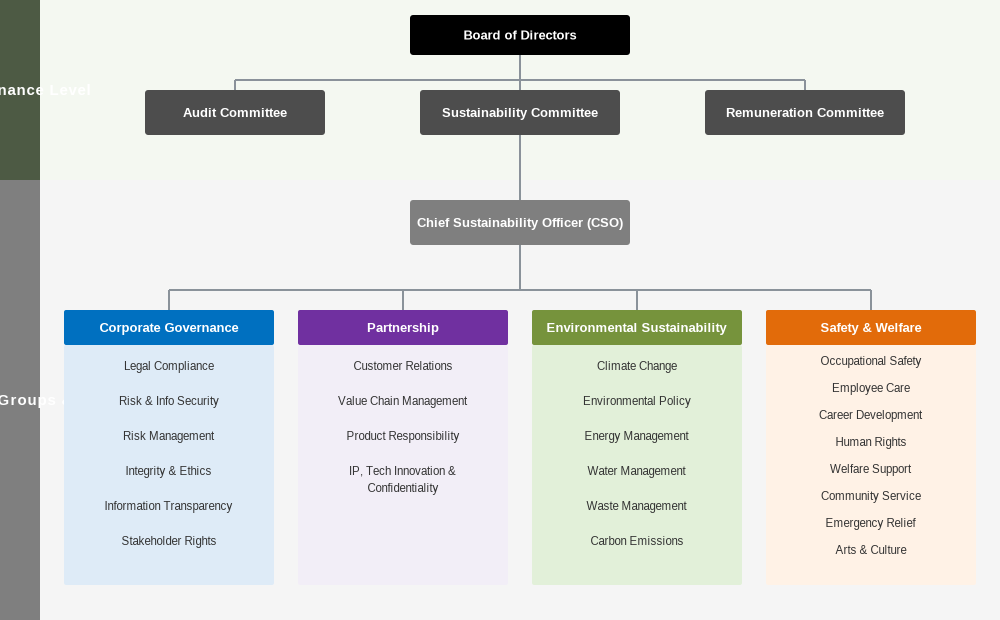
Approved by the Board of Directors, the Group established the Sustainability Development Committee and appointed Executive Vice President Lai Yen-Liang as Chief Sustainability Officer (CSO) to oversee sustainability initiatives. Four dedicated task forces—Environmental Sustainability, Safety & Welfare, Partnership, and Corporate Governance—operate under designated conveners as structured below:
(3) Primary Responsibilities of the Sustainability Development Committee
- 1
Formulate, promote, and strengthen corporate sustainability policies, annual plans, and long-term strategies.
- 2
Review, track, and refine sustainability implementation progress and effectiveness.
- 3
Oversee sustainability information disclosures and review the Sustainability Report.
- 4
Supervise matters under the Sustainable Development Best Practice Principles and other sustainability initiatives resolved by the Board.
- 5
Report corporate sustainability execution status to the Board of Directors on an annual basis.
(4) Functional Task Force Implementation Plans
Environmental Sustainability Task Force
| Focus Area | Implementation Plans & Strategies |
|---|---|
| Energy Management |
|
| Waste Management |
|
| Water Resource Management |
|
| Air Quality Management |
|
| Chemical Management |
|
Safety & Welfare Task Force
| Focus Area | Implementation Plans & Strategies |
|---|---|
| Human Rights & Workplace Safety |
|
| Community Involvement |
|
Partnership Task Force
| Focus Area | Implementation Plans & Strategies |
|---|---|
| Supplier Management |
|
Corporate Governance Task Force
| Focus Area | Implementation Plans & Strategies |
|---|---|
| Board Operations |
|
| Information Security Management |
|
| Stakeholder Communication |
|
| Compliance Advocacy |
|
| Sustainability Assessment Planning |
|
3. Materiality-Based Risk Assessment
Following the materiality principles of our Sustainability Report, we engage with internal and external stakeholders and consolidate assessments across Group departments and subsidiaries to identify material ESG issues and establish effective risk identification, measurement, monitoring, and control measures.
Key identified risks and corresponding management measures are summarized below:
| Risk Category | Potential Risk | Risk Description | Management Measures |
|---|---|---|---|
| Market Risk | International Tariff Fluctuations | Major export markets (such as Europe and the United States) imposing additional tariffs on manufacturing bases (such as China and Vietnam) or revoking GSP preferential treatment could erode price competitiveness. | Strengthen supply chain resilience and advance diversified global manufacturing footprints to flexibly allocate brand orders across production bases and optimize supply costs. |
| Major Investment & Expansion Risk | Cross-Border Labor Market & Workforce Challenges |
| Established cross-departmental evaluation and prudent decision-making mechanisms covering regulatory/policy review, risk identification, and cost modeling, supported by external consultants and local partners. During construction, strict progress tracking, cost controls, and quality inspections ensure timely completion and smooth operational launch. |
| Supply Chain & Raw Material Risk | Raw Material Quality & Supply Disruptions | Plant logistics and procurement continuously monitor supply chain risks including price volatility, supply instability, delivery delays, and inconsistent material quality, alongside potential ESG non-compliance, supplier code violations, labor/environmental lapses, and anti-corruption gaps. | In accordance with the procurement and payment cycle, implement supplier qualification screening, periodic audits, process reviews, and backup supplier qualification to prevent supply disruptions and ensure lawful, sustainable, human-rights-compliant, and ethical procurement. |
| Information Security Risk | Cyberattacks & Trade Secret Protection |
| A. Technical Safeguards
B. Access & Data Governance
C. Monitoring, Audits & Drills
|
| Market Risk | Shortened Product Lifecycles from Fast Fashion |
| Align closely with brand order volumes and designated material suppliers, leveraging Real-Time manufacturing management and AI tools to optimize raw material allocation and operational efficiency. |
4. Sustainability Execution Performance
(1) Environmental (E)
Aligned with global trends, we implement green manufacturing processes and partner with brands on eco-friendly materials and energy-saving decarbonization—optimizing production workflows, investing in automation, and upgrading green technologies. Our China facilities earned the Zero Waste to Landfill Management System Gold Certification in 2025.
To achieve our Group goal of 50% green energy utilization in 2025, we continue installing solar power systems across our China and Vietnam plants. Our China facilities obtained ISO 14001 certification in 2024, followed by our Vietnam facilities in 2025.
(2) Social (S)
Dedicated to employee well-being and social contribution, we safeguard labor rights by establishing labor unions and comprehensive grievance channels at every site while maintaining safe, healthy workplaces. Our China facilities obtained ISO 45001 certification in 2024. In 2025, our Vietnam facilities achieved Social & Labor Convergence Program (SLCP) verification, reducing audit fatigue and redirecting resources toward improving working conditions and strengthening qualification with global brands.
Additionally, our China facilities earned ISO 9001 certification in 2025 to ensure consistent product quality and standardized SOP efficiency. Guided by the philosophy of "giving back to society," all plants execute tailored community and employee care initiatives, including visits to disadvantaged employee families and support for education, safety, and children’s welfare.
(3) Governance (G)
Focusing on digital management and proactive risk prevention, we established a fully digitalized model factory in 2024, actively expanded proprietary digital management systems, and formed an Information Security Team to continuously upgrade cybersecurity governance and operational resilience.
Chung Jye Group received approval for its primary listing application in 2024 and officially listed on the Taiwan Stock Exchange on March 7, 2025. Following the IPO, we continue to strengthen board governance, sharpen market competitiveness, advance global sustainability strategies, solidify long-term brand partnerships, and create enduring shareholder value.
5. Conclusion
Guided by the FSC "Corporate Governance 3.0 – Sustainable Development Roadmap," Chung Jye Group anchors its initiatives around five core pillars:
- 01 Strengthen board functions and enhance corporate sustainable value
- 02 Enhance information transparency to promote sustainable operations
- 03 Strengthen stakeholder communication and foster constructive engagement channels
- 04 Align with international standards and guide stewardship governance
- 05 Deepen corporate sustainability culture and deliver diversified products
We will continue refining key sustainability indicators to elevate enterprise value and serve as a benchmark international corporate citizen.